
Chinese Type 076 Sichuan Amphibious Assault Ship and Future Drone Carrier Conducts First Sea Trial.
China has sent its first Type 076 amphibious assault ship, the Sichuan, to sea for maiden trials from the Hudong Zhonghua yard in Shanghai, only days after commissioning the aircraft carrier Fujian. The 40,000-ton, EMALS-equipped “drone carrier” shows how the PLAN is fusing amphibious lift, carrier aviation, and unmanned mass in a single hull, with direct implications for any conflict around Taiwan and across the first island chain.
China’s first Type 076 amphibious assault ship, the Sichuan (hull 51), has begun its maiden sea trials from Hudong Zhonghua Shipbuilding in Shanghai, marking the debut at sea of what Beijing is openly promoting as a new generation of “drone carrier.” The initial trial period focuses on validating propulsion, electrical power generation, and basic seakeeping in the Yangtze estuary before more complex aviation work-ups in the same waters that hosted earlier Type 075 tests.
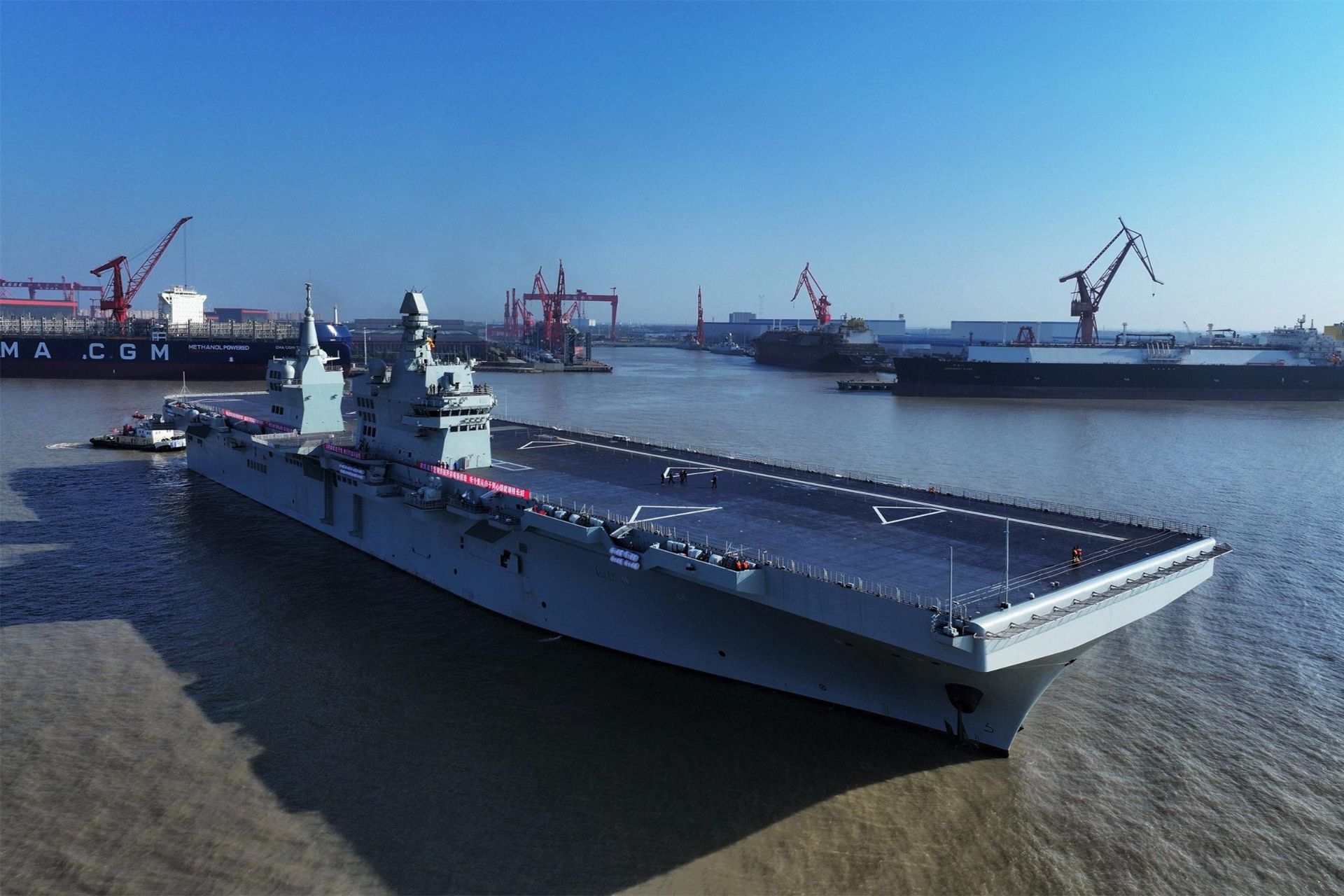
China’s first Type 076 amphibious assault ship Sichuan, fitted with EMALS and billed as a “drone carrier,” has begun sea trials, reshaping regional naval calculus. (Picture source: Chinese MoD)
Within the PLAN, the Type 076 amphibious assault ship, hull number 51, now occupies a place between traditional landing helicopter docks and full-sized carriers. Open sources converge on a full-load displacement above 40,000 tonnes, with a hull around 260 meters in length and roughly 50 meters of beam across the straight flight deck, putting the ship close to US Wasp- and America-class amphibious assault ships in volume. The twin-island superstructure separates navigation functions from aviation and combat management, a layout that China already explores on Fujian and now applies to a mixed amphibious-aviation platform. Compared with the earlier Type 075, the deck is visibly extended to maximize launch and recovery cycles for aircraft and probably drones rather than only helicopters.
For the PLAN, the headline feature is the Electromagnetic Aircraft Launch System (EMALS), installed on an amphibious platform for the first time worldwide. Chinese and foreign analyses indicate at least one long catapult trench, possibly supplemented by a shorter second track, with a total length in the order of 130 meters, comparable in concept to the electromagnetic launchers on Fujian. EMALS demands very high and very stable electrical power, which explains why this first sea trial focuses so explicitly on power generation and distribution. The integrated power system must handle both propulsion and the heavy pulse loads required to fling fixed-wing aircraft and heavy unmanned systems from the deck, while ensuring enough residual capacity for sensors, command systems, and hotel loads.
Below the flight deck, the ship retains a well dock for landing craft and amphibious vehicles, maintaining the DNA of a landing helicopter dock. The vehicle and troop spaces appear sized for brigade-level lift, although the exact troop complement is not disclosed. The aviation complex sits on top of this amphibious core: hangars for helicopters and unmanned platforms, port and starboard aircraft elevators, and a deck layout that can support simultaneous helicopter operations aft and fixed-wing launch and recovery forward. The combination turns the Type 076 into a hybrid between a traditional amphibious assault ship and a light carrier dedicated to air-heavy concepts of operation.
The prospective air wing remains the main point of speculation. Chinese military media already frame Sichuan as a “drone carrier”, repeatedly linking the ship to the GJ-11 Sharp Sword stealth unmanned combat aerial vehicle (UCAV), to reconnaissance UAVs, and to rotary-wing unmanned systems for over-the-horizon targeting and logistics. If EMALS is validated at sea, the ship could, in principle, also support crewed fixed-wing aircraft such as the J-35 carrier-borne fighter, at least in limited numbers, adding air defense and strike options to its amphibious and unmanned profile. The defensive suite visible on imagery already suggests a layered self-protection concept, with multiple HHQ-10 short-range surface-to-air missile launchers and several Type 1130 close-in weapon systems (CIWS) to counter sea-skimming missiles and small air threats in the terminal phase.
The Type 076 is conceived as more than a transport for marines and helicopters. In a Taiwan contingency or in crises along the first island chain, a ship like Sichuan can act as a forward, networked aviation node, fusing data from embarked drones and off-board sensors to contribute to the Recognised Maritime Picture (RMP) and the Common Operating Picture (COP). Swarms of UCAVs and larger MALE drones can probe air defenses, strike coastal nodes, or saturate maritime approaches while the ship remains outside the densest anti-ship missile envelopes, relying on emission control (EMCON) and off-board targeting to limit its exposure. The well deck and amphibious component then provide the classic ability to land troops and vehicles when a window opens, backed by organic air support.
In peacetime and in grey-zone competition, Sichuan gives the PLAN a visible presence tool for the South China Sea and the broader Indo-Pacific. The ship can embark mixed detachments of marines, helicopters, unmanned systems, and command-and-control teams for humanitarian assistance, non-combatant evacuation operations, or coercive shows of force around disputed features. Integration with large surface combatants, submarines, and the carrier Fujian allows the PLAN to experiment with more complex task-group architectures, where an amphibious drone carrier contributes persistent ISR, electronic warfare, and strike while the main carrier focuses on air superiority. For China’s defense industrial base (BITD), the platform also showcases mastery of integrated electric propulsion, large composite islands, and high-energy electromagnetic systems, areas that feed into future carrier and surface combatant programs.
At the geopolitical level, the maiden trial of Sichuan confirms that China’s naval modernization is expanding not only in hull numbers but in concept, blending amphibious warfare, carrier aviation, and unmanned mass on a single hull. Regional navies now have to factor in a PLAN asset that can move large landing forces, generate continuous drone and helicopter sorties, and operate alongside blue-water carrier groups. For the United States and its allies, the Type 076 underlines the need to adapt counter-amphibious and counter-drone doctrines, including long-range fires, distributed maritime operations, and resilient logistics, to handle a fleet in which “drone carriers” become routine. As sea trials progress and the ship moves toward expected delivery around 2026, Sichuan quietly shifts the balance of maritime power projection in East Asia and complicates crisis planning around Taiwan and in the wider Indo-Pacific.