
France Poised To Choose Arquus and Daimler For €5 Billion Army Truck Fleet Renewal.
France has reportedly chosen Arquus, teamed with Daimler Truck, as the preferred bidder for its long-awaited 5 billion euro FTLT logistics and tactical truck program covering up to 7,000 vehicles. If confirmed, the decision would reshape French Army mobility and strengthen interoperability with NATO forces that operate similar European truck families.
According to information published by La Tribune, on 14 November 2025, the French defense procurement agency Direction générale de l’armement has selected Arquus, in partnership with Daimler Truck, as the preferred bidder for what many already describe as the “contract of the century” in military trucks, a long term programme worth around 5 billion euros for up to 7,000 logistics and tactical vehicles. The article, based on converging industrial sources, asserts that the DGA has made its choice in favour of Arquus for the “Flotte tactique et logistique terrestre” programme, even though no official award notice has yet appeared in the government’s tender bulletins.
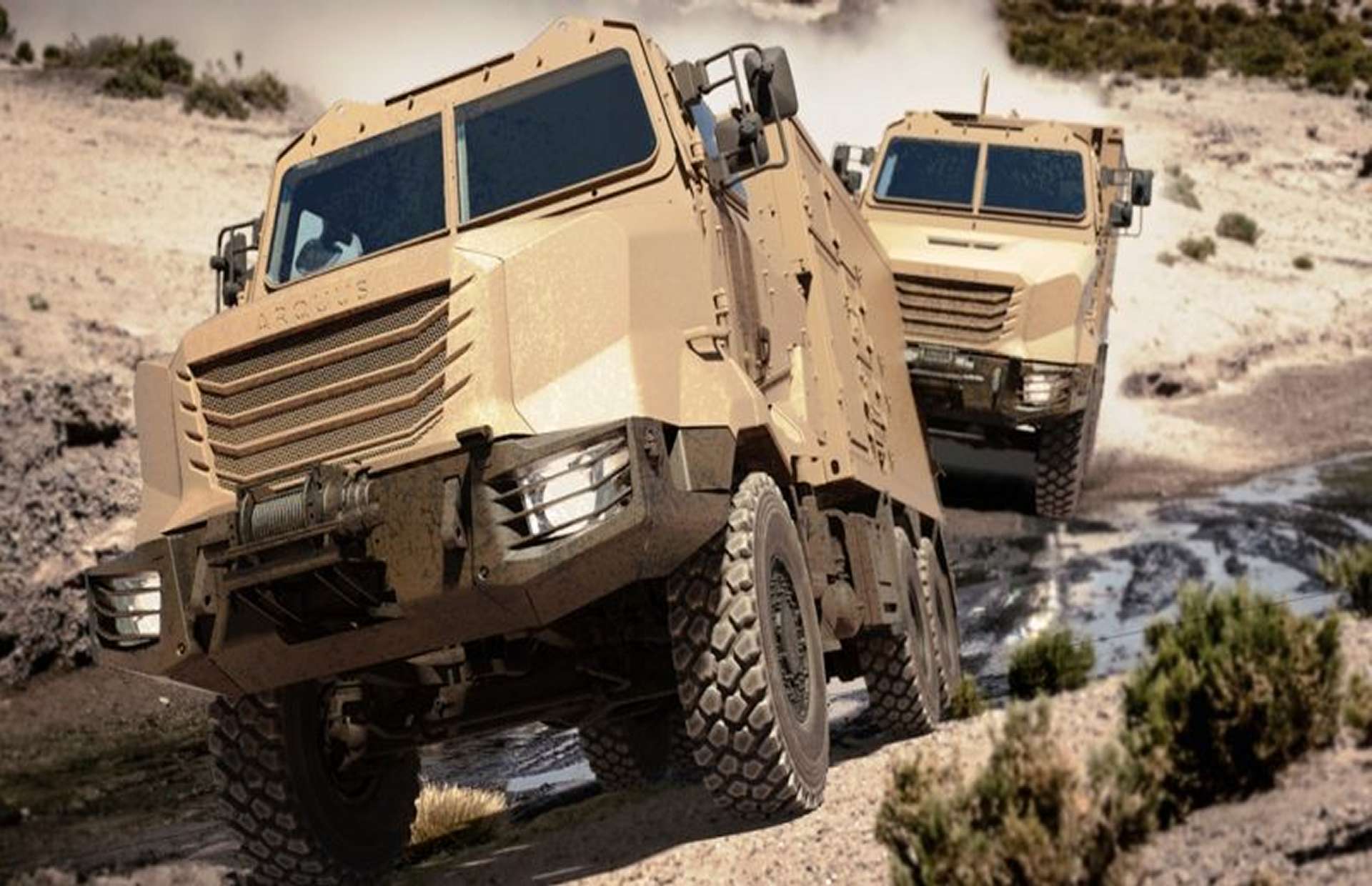
Arquus’s new Armis trucks offer protected cabs, high off-road mobility, and greater payload capacity, giving the French Army a modern, modular logistics backbone for frontline operations (Picture source: Arquus).
At the time of writing, the Ministry of the Armed Forces and the DGA have not publicly confirmed the result and the tender formally remains in progress. However, the scenario described by La Tribune is consistent with the structure of the FTLT call for tenders and with several other open source reports, which all point towards an imminent award: a single framework contract covering a maximum of 7,000 six-ton class off-road trucks over roughly twelve years, with a projected value of around 5 billion euros if all options are exercised. FranceRoutes, Clubic, Armees.com and specialist blog Forces Operations all describe the same contours, while OpexNews has already documented the offensive mounted by the Arquus–Daimler pair with the “Zetros by Arquus” demonstrator unveiled at the 2025 Forum Entreprises Défense.
This article is based on La Tribune’s revelations, cross-checks with official tender documentation, parliamentary reports on the 2024–2030 defence programming law, prior DGA notices and multiple open source industrial and operational analyses. It should be read as an informed assessment rather than a definitive confirmation: until the DGA publishes its formal award, the result remains technically provisional and could be subject to adjustment or challenge.
The FTLT programme sits at the heart of the French Army’s land logistics modernisation. According to the DGA’s July 2024 tender, the contract covers the acquisition and support of a maximum of 7,000 off-road “porteurs logistiques” including their mission equipment, in service support and technical fleet management, with deliveries spread over a little more than twelve years. These trucks, in the 6-ton payload class, must be capable of operating on rough terrain, be air transportable, and for a substantial share of the fleet offer ballistic and mine/IED protection compatible with current theatres of operation. The call for tenders restricted competition to European industrial players capable of producing at least 1,000 military trucks per year and demonstrating a turnover of at least 600 million euros over the previous three financial years, which in practice narrowed the field to four contenders: Arquus with Daimler Truck, Soframe with Iveco Defence Vehicles, MAN and Scania.
France still operates around 27,000 trucks in the land forces, many of them over thirty years old. The legendary but aging Berliet/Renault GBC 180, TRM 2000, and VLRA families remain in frontline and training service, with soaring maintenance costs and availability figures that no longer match the tempo required for high-intensity combat. Exercises such as Orion 2023 exposed these weaknesses, with parliamentary reporting highlighting the need to reinforce logistic depth and increase the proportion of protected vehicles in logistics units. Both the 2019–2025 and 2024–2030 defence programming laws mention the renewal of up to 7,000 trucks by 2030 as a central objective for the Army’s transformation towards high-intensity operations, but actual implementation has been repeatedly delayed in favour of combat systems such as Scorpion vehicles and artillery.
If the information now circulating is confirmed, the core of the future FTLT fleet will therefore be built around the Zetros and, likely in lighter roles, Unimog families from Daimler Truck, militarised, protected, and supported by Arquus in France. At the Forum Entreprises Défense in October 2025, Arquus presented the “Zetros by Arquus,” a 6×6 chassis with more than 6 tonnes of payload, available in protected or unprotected versions and fitted with a French-designed cabin optimised for harsh environments. Reporting indicates that this configuration targets the 6 ton payload class defined by the FTLT tender, with a two-seat cab, global user base, and an architecture compatible with multiple mission modules, from troop and cargo transport to specialised engineer or systems carriers.
Although detailed technical data for the French configuration is not yet public, the baseline Zetros family provides useful indicators. The latest 6×6 variants show gross vehicle weights around 30 to 40 tonnes, depending on configuration, central tyre inflation, fording depth around 1.2 metres, gradient performance approaching 100 percent and cross-country mobility adapted to heavy logistics and combat engineering roles. Armoured cabin options are designed to reach at least STANAG 4569 Level 2, offering resistance against 7.62 mm armour-piercing ammunition and protection against specific underbody blast threats.
The Arquus–Daimler offer is structured as a family of vehicles. A 4×4 platform in the Unimog class would cover company-level logistics and light troop transport, replacing TRM 2000s in ammunition resupply, rations, and field support tasks. Above that, 6×6 Zetros-based variants will form the backbone of operational logistics, including flatbeds, container carriers, and hook lift systems for ISO modules, engineer stores and bridging equipment. For heavy combat engineering or recovery roles, the architecture allows for larger derivatives in future tranches if the DGA chooses to expand the fleet.
Each variant is expected in protected and unprotected versions. Protected configurations will support high-threat missions, while unarmoured trucks will serve training and lower-intensity tasks. Because the contract covers fleet support and technical management, the trucks are expected to integrate embedded diagnostics, digital fleet monitoring, and predictive maintenance systems. Arquus and Daimler both bring substantial experience in these fields, opening the door to genuinely predictive logistics for the French Army.
The new fleet will significantly change how French brigades sustain operations. In a high-intensity scenario similar to Orion 2023, a single brigade can require hundreds of daily truck sorties to support artillery, armoured battalions and engineers. Older platforms struggled with availability, crew protection and ergonomics. With hook lift systems, modular payloads and modern drivetrains, the FTLT fleet will move greater tonnage with fewer vehicles, better protection and faster loading cycles. It is designed to keep pace with dispersed combined arms battlegroups, enabling French formations to maintain tempo within NATO’s timelines.
This fleet renewal also aligns with the 2024–2030 defense programming law. By 2030, around 2,000 trucks should have entered service, with deliveries continuing toward the full 7,000 objective in the following decade. Protected variants will become more common in logistics regiments, reflecting lessons drawn from Ukraine and from NATO’s renewed focus on survivability in rear areas.
Why would Arquus and Daimler have prevailed? Price appears to have played a decisive role, with the consortium reportedly undercutting all rivals. A militarised commercial chassis, such as Zetros or Unimog, already benefits from economies of scale, which is difficult for bespoke designs to match. The second factor is industrial: the tender demanded a capacity of roughly 1,000 trucks per year. The combined industrial footprint of Arquus factories in France and Daimler’s major production facilities gives the consortium unmatched production depth within the competition. The “Zetros by Arquus” reveal in 2025 showed a Franco–German team already preparing the ground.
Arquus’ strong recent record in tanker fleet modernisation, combined with the financial backing of the John Cockerill group, reinforces the credibility of its offer. Support infrastructure, protected cab production and export potential all appear aligned with the scale of the FTLT contract.
Competitors nonetheless brought strong arguments. Soframe and Iveco Defence Vehicles proposed a solution building on the proven PPT 8×8, a heavy logistics truck with real protected mobility and a solid operational record. MAN offered the highly successful HX/HX2 family used across NATO, likely the most globally standardised tactical truck solution in the running. Scania, meanwhile, leveraged its Scandinavian logistics portfolio and recent large military orders. But none of these competitors combined cost competitiveness, modularity across weight classes and French industrial sovereignty to the same degree as Arquus and Daimler.
The FTLT contract also includes training, simulators, maintenance tooling and technical documentation. The shift to predictive fleet support will require new maintainer skills, standardised simulator-based driver training and a tighter human–machine interface across thousands of trucks. For an Army that must rapidly expand its logistic workforce, this unified training ecosystem is a decisive enabler. But despite strong converging indications, the final step is still to come. The DGA must publish the official award notice, and competitors retain the right to challenge or seek clarification. Final negotiation may still adjust the proportions of protected and unprotected variants, remote weapon station integration, or the pace of deliveries.